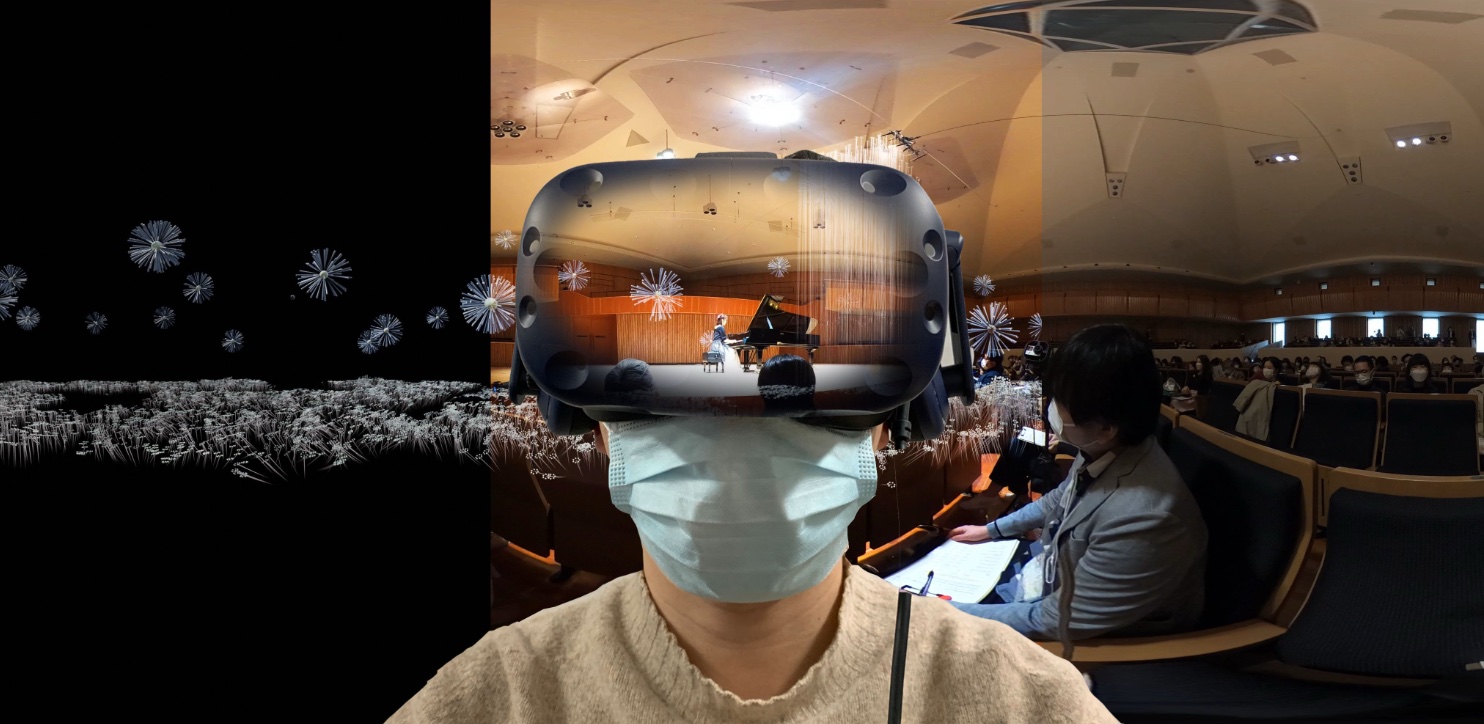
Cross-temporal physiological synchrony in VR concert recreation. Left: abstract symbolic visualization of audience EDA data. Center: a VR participant wearing a headset during the recreated concert. Right: the original live concert audience.
Can a VR recreation of a concert make you feel like you were actually there? We explore this question in our latest paper, presented at the Augmented Humans conference 2026 in Okinawa, and the answer surprised us: less realism actually works better.
The core idea is cross-temporal physiological synchrony. We recorded electrodermal activity (EDA) from 40 audience members at a live piano concert, then transformed that data into visualizations embedded in VR recreations of the same concert. 22 participants later experienced these recreations while we measured their own physiological responses, comparing them to the original audience.
We tested three levels of visual abstraction: realistic 360-degree video, a mixed condition blending video with physiological overlays, and a fully abstract symbolic visualization where the audience’s arousal patterns became dandelion-like particle effects floating in a dark space. The hypothesis going in was that realism would win.
It did not. The abstract condition produced the strongest physiological synchrony with the original live audience (r = .96, p < .001), significantly outperforming both the mixed (r = .92) and realistic video (r = .91) conditions. During musical climaxes, the abstract visualization maintained strong correlation while realistic video showed none. Stripping away visual realism while preserving the physiological patterns actually made people’s bodies respond more like the original audience.
This has interesting implications for how we think about recreating shared cultural experiences in VR. Faithful audiovisual reproduction is not enough – the collective physiological atmosphere matters, and sometimes an abstract representation of that atmosphere connects people more effectively than a photorealistic one.
Citation
Xiaru Meng, Yulan Ju, Matthias Hoppe, Jiawen Han, Yan He, Kouta Minamizawa, and Kai Kunze. 2026. Abstraction Beats Realism: Physiological Visualizations Enhance Arousal Synchrony in VR Concert Recreations. In The Augmented Humans International Conference 2026 (AHs 2026), March 16–19, 2026, Okinawa, Japan. ACM, 1–13. https://doi.org/10.1145/3795011.3795059