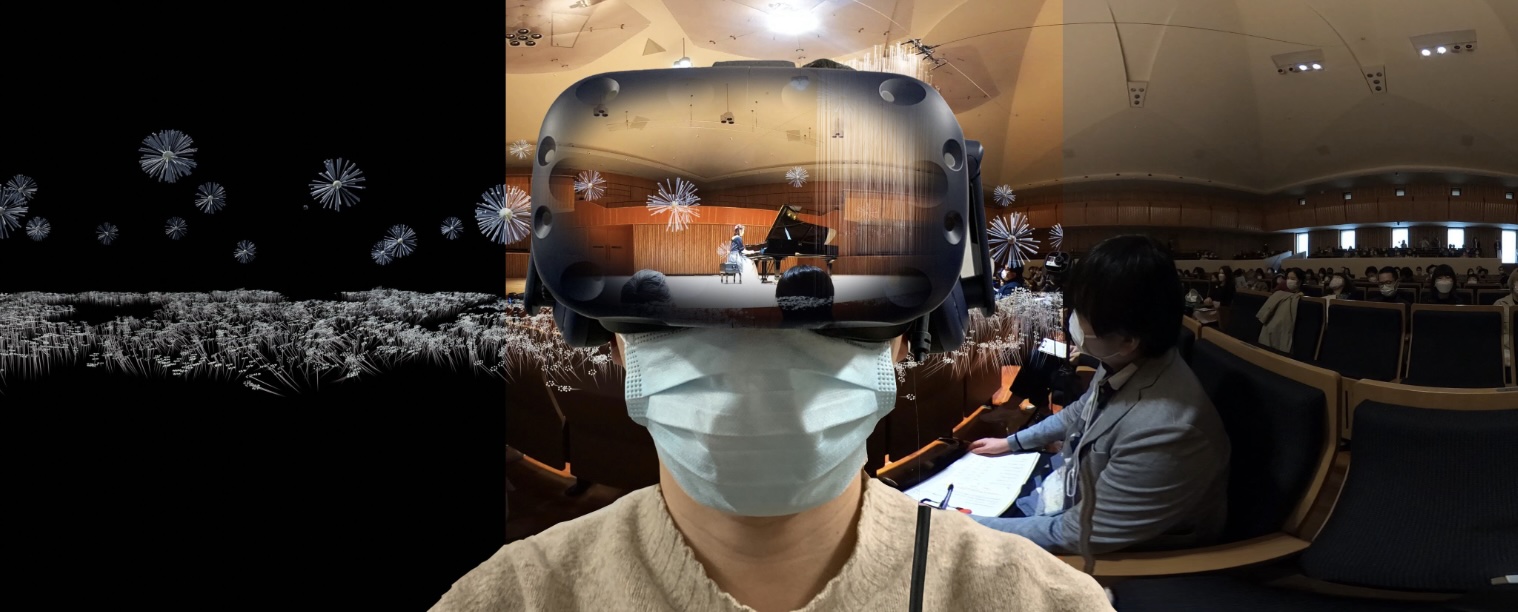
Virtual reality promises to transport us to events we could never attend in person. Concert recreations in VR have become increasingly sophisticated, aiming to capture not just the sights and sounds of a performance, but the atmosphere created by a live audience. But what happens when we try to recreate that collective energy using physiological data from the original audience? And does it matter if that data is real or fake?
We recently conducted a study lead by Xiaru Ming that brings these questions into focus. The research examines how visualizing audience physiological data in VR concert recreations affects user experience. The findings reveal a placebo effect that challenges assumptions about the role of authentic data in creating meaningful experiences.
The study centered on a classical piano concert recreation in VR. We collected electrodermal activity and blood volume pulse data from 50 audience members during a live performance. This data was then transformed into abstract 3D visualizations—organic forms resembling dandelions and grass that moved and scaled according to the physiological responses of the original audience.
The experimental design compared four conditions: no visualization, real matched data from the actual concert, real unmatched data from a different performance, and randomly generated fake data. Participants were split into two groups. One group received no explanation about the visualizations. The other was told the visuals represented physiological data from previous audience members.
The uninformed group struggled to make sense of the visualizations. Nineteen participants reported confusion and distraction. One described the experience as making them “feel very small and very overpowered” by visuals they could not interpret. When confronted with the rapidly moving fake data condition, they felt rushed and pressured rather than engaged.
The informed group showed a different pattern entirely. Simply knowing that the visualizations represented other audience members increased engagement and co-presence across all conditions. Participants reported feeling connected to a collective experience. They described the visuals as helping them “imagine if there are other people also in that environment.”
What makes this particularly interesting is the response to the fake data condition. In the uninformed group, the randomly generated visualizations with their rapid movements created negative emotions; participants felt overwhelmed and distracted. But in the informed group, the same fake data produced the highest levels of pleasure and arousal. Participants interpreted the rapid movement as indicating a highly engaged audience, which in turn made them feel more active and engaged themselves.
This interpretation was not just subjective. The physiological data showed that participants in the informed group who viewed fake visualizations achieved higher synchrony with the original live audience in terms of tonic electrodermal activity—the slow, sustained changes in arousal that reflect overall emotional state. Their bodies were responding as if they truly were experiencing the concert alongside an excited crowd, even though that crowd was entirely fictional.
The mechanism at work here resembles social facilitation theory. When people believe others are present and engaged, they tend to align their own behavior and emotions with that perceived social environment. The fake data, because it was more dynamic than the real data, created the impression of a highly active audience. Participants who believed this reflected real audience responses mirrored that perceived energy in their own experience.
This finding has started to gain relevance in human-computer interaction research more broadly. The placebo effect in HCI has been documented in various contexts, from adaptive interfaces to AI systems. Studies have shown that when users believe a system is enhanced by AI or adaptive algorithms, they perceive better performance and higher trustworthiness—even when the system provides no actual enhancement. Our work demonstrates this extends to physiological data visualization.
The implications are both practical and methodological. For designers creating VR event recreations or social VR experiences, the findings suggest that providing context about visualizations matters more than ensuring perfect accuracy. A well-designed abstract representation with proper framing can create stronger engagement than authentic data presented without explanation. The study also reveals a trade-off: while dynamic visualizations enhanced sustained emotional resonance, they disrupted moment-to-moment physiological alignment, suggesting designers need to balance long-term engagement with immediate synchrony.
From a research perspective, the work raises questions about how we evaluate systems that visualize physiological data. If user responses depend heavily on their beliefs about what the data represents, studies that fail to include placebo conditions may conflate genuine effects with expectancy-driven responses. This becomes particularly important as physiological data visualization becomes more common in fitness applications, meditation apps, and social platforms.
The study also revealed that most participants could not distinguish between matched and unmatched real data conditions. Only those with expertise in physiological data analysis could identify which visualizations corresponded to the actual concert performance. This suggests that for general audiences, the authenticity of collective physiological data may be less important than its interpretability and the narrative provided about its meaning.
These findings do not diminish the value of real data. Rather, they complicate our understanding of what makes data meaningful in experiential contexts. The abstract organic forms used in the study were purposefully ambiguous, allowing participants to project their own interpretations onto the visualizations. This ambiguity, combined with a basic explanation of what the data represented, created space for the placebo effect to emerge.
The work leaves several questions open. Would the placebo effect persist if participants were explicitly told some conditions used fake data? Can designers leverage this effect ethically to create more engaging experiences? What happens to physiological synchrony when users develop expertise in reading these visualizations? These questions point to productive directions for future research at the intersection of physiological computing, social VR, and perception design.
As VR and mixed reality technologies continue to develop, we will see increasing attempts to recreate and augment social experiences. Understanding how beliefs and expectations shape these experiences, sometimes more powerfully than the underlying data itself, will be essential for designers and researchers working in this space. The placebo concert demonstrates that in virtual worlds, what people believe about their experience can be as important as the technical systems supporting that experience.
Citation
Xiaru Meng, Yulan Ju, Christopher Changmok Kim, Yan He, Giulia Barbareschi, Kouta Minamizawa, Kai Kunze, and Matthias Hoppe. 2025. A Placebo Concert: The Placebo Effect for Visualization of Physiological Audience Data during Experience Recreation in Virtual Reality. In Proceedings of the 2025 CHI Conference on Human Factors in Computing Systems (CHI ‘25). Association for Computing Machinery, New York, NY, USA, Article 807, 1–16. https://doi.org/10.1145/3706598.3713594