The crossword of sums.
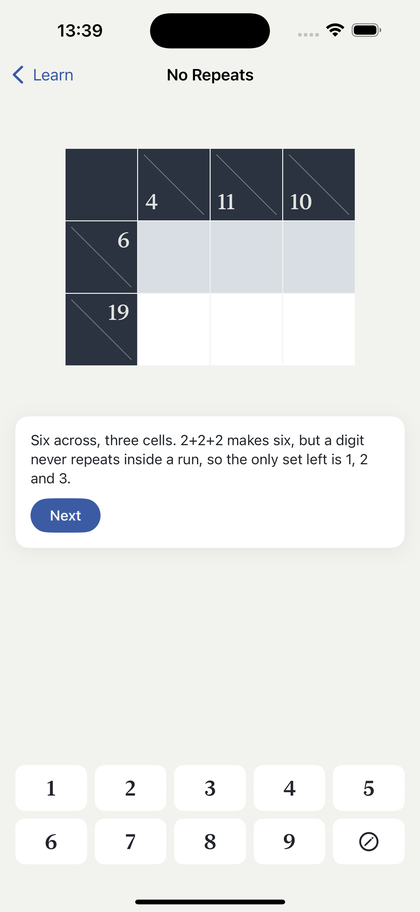
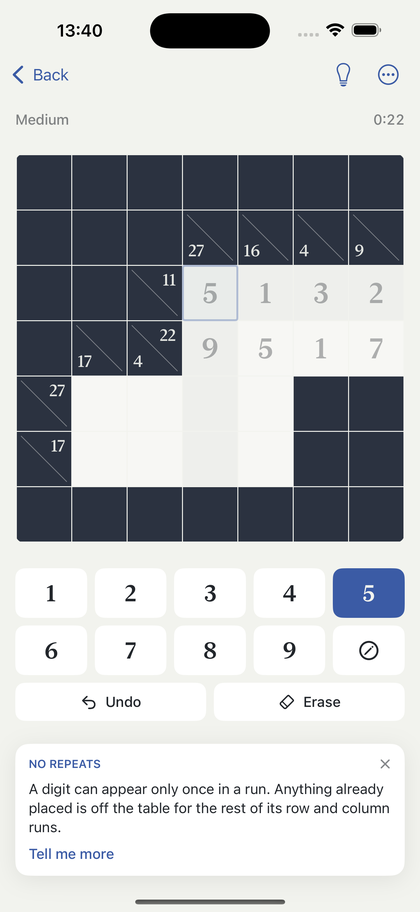
Every run of white cells adds up to its clue, and no digit repeats inside a run. That is the whole rulebook. Getting good at it is another matter, which is what the app is for.
Try one
Pick a cell, then a digit. Or use the arrow keys and type.
How the app teaches
Nine lessons take you from the rules to the techniques experienced solvers use without thinking: magic blocks, cross-referencing, min-max bounds, hidden singles, combination logic. The board above is the one from the second lesson.
When you get stuck in a real game, the hint button names the technique that applies and shows you why it works. It will fill the cell in if you insist, but that is the last thing it offers rather than the first.
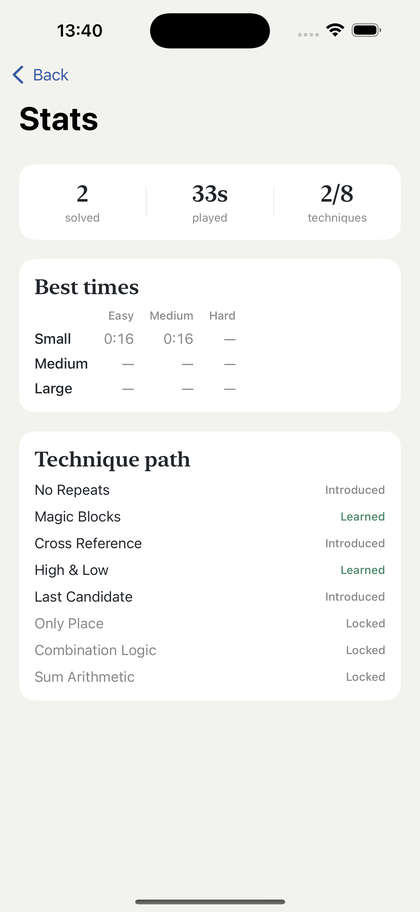
Practice drills let you rehearse one technique at a time. Mastery counts only the deductions you worked out yourself, so the progress path reflects what you can do rather than how often you tapped the lightbulb.
One solution, always
This is checked rather than assumed. Before a board reaches you it is proved to have exactly one solution and to be finishable by reasoning alone. You are never asked to guess, and a board that fails either test is never shown.
What it costs
Free
- The rules lesson, No Repeats and Magic Blocks
- Small and medium boards at every difficulty
- An error check when something has gone wrong
One purchase
- Six more lessons
- Every practice drill
- Hints that teach instead of just answering
- Large boards, stats and the technique path
No ads, no subscription, and none of the timers, energy or coins that puzzle apps tend to arrive with. Everything works offline.
Privacy
Just Kakuro does not collect any personal data. There is no account to create, nothing to log in to, and no analytics or advertising code in the app.
Your settings, progress, best times and technique mastery are saved on your device using the system's standard preferences storage. That data never leaves your device, and deleting the app deletes all of it.
The one optional purchase is handled entirely by Apple. The app asks Apple whether the purchase has been made and stores only that yes-or-no answer on your device. Payment details are never seen by the app or by me.
Apart from that purchase check, the app does not connect to the internet. Puzzles are generated on your device.
Support
- I bought it and it is asking me to buy again.
- Open Settings inside the app and tap Restore purchases. Make sure you are signed in with the Apple Account you bought it with.
- Does it work offline?
- Yes. Puzzles are generated on your device. The only time the app needs a connection is to check or restore a purchase.
- Where is my progress kept?
- On your device, and nowhere else. Deleting the app deletes it too.
- A board looks unsolvable.
- Please tell me, and mention the size and difficulty. Every board is machine checked before it ships, so a counterexample is worth having.
Bug reports and suggestions go to kai.kunze@gmail.com.