Ubicomp ISWC Impressions

Usually, I’m not such a big fan of conference openings, yet Friedemann Mattern provided a great intro giving an overview about the origins of Pervasive and Ubicom mentioning all important people and showing nice vintage pictures from Hans Gellersen, Alois Ferscha, Marc Langheinrich, Albrecht Schmidt, Kristof Van Laerhoven etc.

Deeply impressed by the organization, social and general talk quality, I was a bit sceptical before the merger of Pervasive / Ubicom and collocating ISWC, yet it was completely unfounded.

[Read More]
Excited about Ubicomp and ISWC

This year I’m really looking forward to Ubicomp and ISWC, it’s the first time that Ubicomp and Pervasive merged into one conference and it’s the first time the venue sold out with 700 participants.

I cannot wait to chat with old friends and experts (most are both :)).

The field slowly matures. Especially, the wearable research is really pushing towards prime-time. Most prominently, Google Glass is getting a lot of focus also discussing its impacts on privacy. Yet, there is more and more talk about fitness bracelets/trackers and smart watches. I expect that we see more intelligent clothes and activity recognition work in commercial products in the coming years.

[Read More]

Recognizing Reading Activities

Just finished my keynote talk at CBDAR (Workshop of ICDAR), got a lot of questions and have a lot of new research ideas :)

I’m pretty ignorant about Document Analysis (and Computer Vision in general), so it’s great to talk to some experts in the field. Pervasive Computing and Document Analysis are very complementary and as such interesting to combine.

Here are my talk slides, followed by the talk abstract.

[Read More]

Kai @ CHI

So it’s my first time at CHI. Pretty amazing so far … Will blog about more later.

Chi Poster Kai@CHI

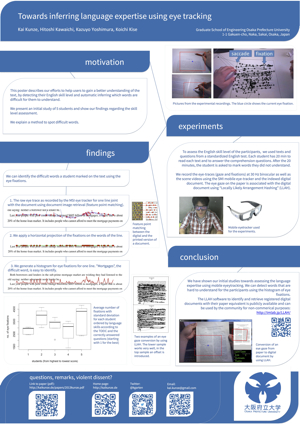
I’m in the first poster rotation, starting this afternoon: “Towards inferring language expertise using eye tracking” Drop by my poster if you’re around (or try to spot me, I’m wearing the white “Kai@CHI” Shirt today :)).

Here’s the abstract of our work, as well as the link to the paper.

“We present initial work towards recognizing reading activities. This paper describes our efforts detect the English skill level of a user and infer which words are difficult for them to understand. We present an initial study of 5 students and show our findings regarding the skill level assessment. We explain a method to spot difficult words. Eye tracking is a promising technology to examine and assess a user’s skill level.”

Activity Recognition Dagstuhl Report Online

If you wonder how we spent German tax money, the summary of the Activity Recognition Dagstuhl seminar is now online.

Human Activity Recognition in Smart Environments (Dagstuhl Seminar 12492)


Here’s the abstract:

This report documents the program and the outcomes of Dagstuhl Seminar 12492 “Human Activity Recognition in Smart Environments”. We established the basis for a scientific community surrounding “activity recognition” by involving researchers from a broad range of related research fields. 30 academic and industry researchers from US, Europe and Asia participated from diverse fields including pervasive computing, over network analysis and computer vision to human computer interaction. The major results of this Seminar are the creation of a activity recognition repository to share information, code, publications and the start of an activity recognition book aimed to serve as a scientific introduction to the field. In the following, we go into more detail about the structure of the seminar, discuss the major outcomes and give an overview about discussions and talks given during the seminar.