Wordometer and Document Analysis using Pervasive Sensing

wordometer

In the last couple of months, I got more and more interested in learning, especially reading. Loving tech and sports, I got easily hooked on the Quantified Self movement (I own a Zeo Sleeping Coach and several step counters). Seeing how measuring myself transformed me. I lost around 4 kg and feel healthier/fitter, since I started tracking. I wonder why we don’t have similar tools for our learning behavior.

[Read More]

Kai @ CHI

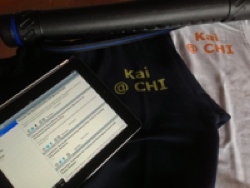
So it’s my first time at CHI. Pretty amazing so far … Will blog about more later.

Chi Poster Kai@CHI

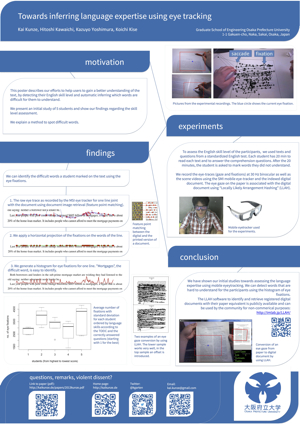
I’m in the first poster rotation, starting this afternoon: “Towards inferring language expertise using eye tracking” Drop by my poster if you’re around (or try to spot me, I’m wearing the white “Kai@CHI” Shirt today :)).

Here’s the abstract of our work, as well as the link to the paper.

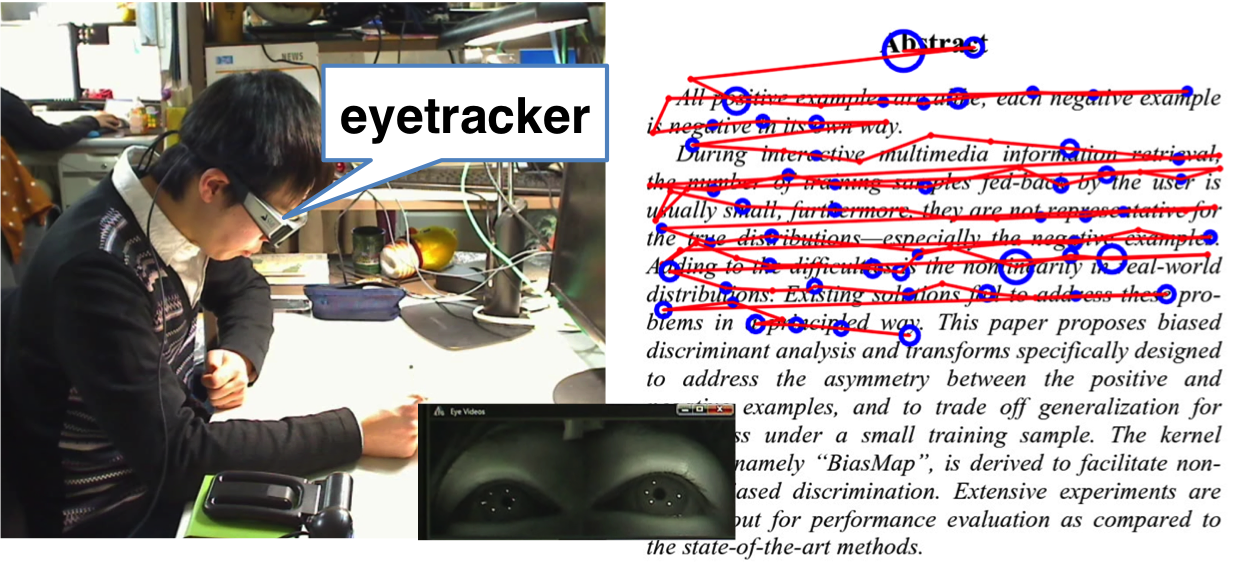
“We present initial work towards recognizing reading activities. This paper describes our efforts detect the English skill level of a user and infer which words are difficult for them to understand. We present an initial study of 5 students and show our findings regarding the skill level assessment. We explain a method to spot difficult words. Eye tracking is a promising technology to examine and assess a user’s skill level.”

Activity Recognition Dagstuhl Report Online

If you wonder how we spent German tax money, the summary of the Activity Recognition Dagstuhl seminar is now online.

Human Activity Recognition in Smart Environments (Dagstuhl Seminar 12492)


Here’s the abstract:

This report documents the program and the outcomes of Dagstuhl Seminar 12492 “Human Activity Recognition in Smart Environments”. We established the basis for a scientific community surrounding “activity recognition” by involving researchers from a broad range of related research fields. 30 academic and industry researchers from US, Europe and Asia participated from diverse fields including pervasive computing, over network analysis and computer vision to human computer interaction. The major results of this Seminar are the creation of a activity recognition repository to share information, code, publications and the start of an activity recognition book aimed to serve as a scientific introduction to the field. In the following, we go into more detail about the structure of the seminar, discuss the major outcomes and give an overview about discussions and talks given during the seminar.

Some of my favorites from the 29c3 recordings

Over the last weeks, I finally got around to watch some of the 29c3 recordings. Here are some of my favorites. I will update the list accordingly.

I link to the official recording available from the CCC domain. The talks however are also on youtube. Just search for the talk title.

In General, I found most talks focused on security, sadly not really my main interest. I missed some research and culture talks that were present the last years. Examples from the last years:Data Mining for Hackers awesome talk!! or one of Bicyclemark episodes. Bicylcemark we miss you :)

[Read More]

ACM Multimedia 2012 Main Conference Notes

This is a scratchpad … will fill the rest when I have time.

Papers

I really enjoyed the work from Heng Liu, Tao Mei et. al. “Finding Perfect Rendezvous On the Go: Accurate Mobile Visual Localization and Its Applications to Routing”. They combine existing research in a very interesting mixture. They use a visual localization method based on bundler to detect where in the city a mobile phone user is. The application scenario I liked best was their collaborative localization for rendezvous :)

[Read More]

ACM Multimedia 2012 Tutorials and Workshops

I attended the Tutorials “Interacting with Image Collections – Visualisation and Browsing of Image Repositories” and “Continuous Analysis of Emotions for Multimedia Applications” on the first day.

The last day I went to “Workshop on Audio and Multimedia Methods for Large Scale Video Analysis” and to the “Workshop on Interactive Multimedia on Mobile and Portable Devices”.

This is meant as a scratchpad … I’ll add more later if I have time.

[Read More]

Laughing Faces App in the AppStore

Over the last couple of weeks, I was getting settled in my new job. As I’m working with computer vision researchers now, I started playing with the camera api for the iPhone.

Again, I’m very surprised by the accessibility and quality of Apples apis and their sample code.

As a start, this little app is a “privacy enhanced” camera app for entertainment purposes. It uses face detection and draws a little laughing face on top of each recognized head in real time. I hesitated putting it in the store, yet was asked by some friends to do so (had to exchange the laughing face due to copyright constraints).

[Read More]

AAAI activity context workshop notes

I enjoyed the AAAI context activity workshop a lot.

The keynote How to make Face Recognition work (pdf) by Ashis Kapoor showed how to increase face recognition introducing very simple “context” constrains (two people in the same image cannot be the same person etc.). Very interesting work, I wonder how much better you can get introducing some more dynamic context recognition to the face recognition task.

Gail Murphy gave the other keynote Task Context for Knowledge Workers (pdf). She introduces context modelling for tasks in GTD scenarios. Also quite interesting, as completely complimentary to my work (no mobile clients, sensors etc.).

[Read More]

Towards Dynamically Configurable Context Recognition Systems

Here’s a draft version of my publication for the Activity Context Workshop in Toronto. Bellow the abstract.

Here’s the link to the source code for snsrlog for iPhone (which I mentioned during my talk).


Abstract

General representation, abstraction and exchange definitions are crucial for dynamically configurable context recognition. However, to evaluate potential definitions, suitable standard datasets are needed. This paper presents our effort to create and maintain large scale, multimodal standard datasets for context recognition research. We ourselves used these datasets in previous research to deal with placement effects and presented low-level sensor abstractions in motion based on-body sensing. Researchers, conducting novel data collections, can rely on the toolchain and the the low-level sensor abstractions summarized in this paper. Additionally, they can draw from our experiences developing and conducting context recognition experiments. Our toolchain is already a valuable rapid prototyping tool. Still, we plan to extend it to crowd-based sensing, enabling the general public to gather context data, learn more about their lives and contribute to context recognition research. Applying higher level context reasoning on the gathered context data is a obvious extension to our work.
Some of my publications are online

I am currently in the process of uploading my research publications to this website. In the publications section, you’ll find select papers, including PDF drafts of my work. I will be regularly updating this collection with additional publications and their corresponding BibTeX citations.