A Week with Glass

How my grandparents interact with GLASS, showed me that Google seems to be onto something.

As there were a lot of researchers visiting for the Ubicomp /ISWC conferences, I could grab a Google Glass from one of the participants for a week. Thanks to the anonymous donor (to avoid speculations it was none of the people mentioned below). In the following some unsorted thoughts … Sorry for typos etc. It’s more a scratch pad so I don’t forget the impressions I had.

[Read More]

ICDAR 2013 Talk Slides Online

The slides for my two talks today are online now.

The Wordometer

Reading activity recognition using an off-the-shelf EEG

For more details, check out the papers:

They are both published at ICDAR 2013.

Recognizing Reading Activities

Just finished my keynote talk at CBDAR (Workshop of ICDAR), got a lot of questions and have a lot of new research ideas :)

I’m pretty ignorant about Document Analysis (and Computer Vision in general), so it’s great to talk to some experts in the field. Pervasive Computing and Document Analysis are very complementary and as such interesting to combine.

Here are my talk slides, followed by the talk abstract.

[Read More]

Wordometer and Document Analysis using Pervasive Sensing

wordometer

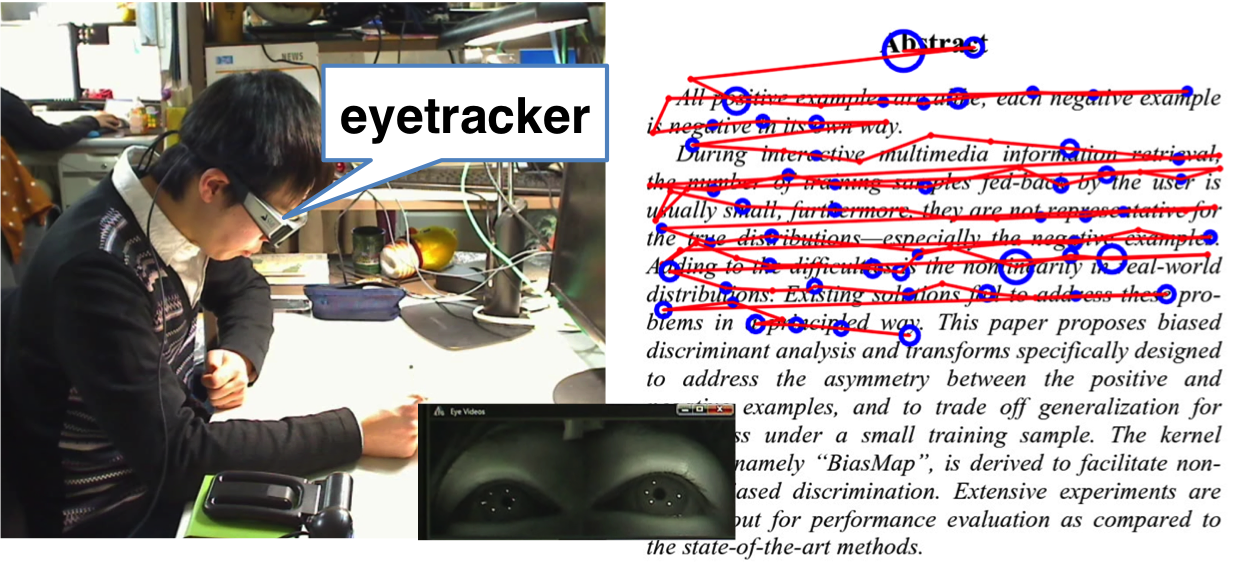
In the last couple of months, I got more and more interested in learning, especially reading. Loving tech and sports, I got easily hooked on the Quantified Self movement (I own a Zeo Sleeping Coach and several step counters). Seeing how measuring myself transformed me. I lost around 4 kg and feel healthier/fitter, since I started tracking. I wonder why we don’t have similar tools for our learning behavior.

[Read More]

Activity Recognition Dagstuhl Report Online

If you wonder how we spent German tax money, the summary of the Activity Recognition Dagstuhl seminar is now online.

Human Activity Recognition in Smart Environments (Dagstuhl Seminar 12492)


Here’s the abstract:

This report documents the program and the outcomes of Dagstuhl Seminar 12492 “Human Activity Recognition in Smart Environments”. We established the basis for a scientific community surrounding “activity recognition” by involving researchers from a broad range of related research fields. 30 academic and industry researchers from US, Europe and Asia participated from diverse fields including pervasive computing, over network analysis and computer vision to human computer interaction. The major results of this Seminar are the creation of a activity recognition repository to share information, code, publications and the start of an activity recognition book aimed to serve as a scientific introduction to the field. In the following, we go into more detail about the structure of the seminar, discuss the major outcomes and give an overview about discussions and talks given during the seminar.