Eye-Wear Computing

Smart glasses and, in general, eyewear are a fairly novel device class with a lot of possibilities for unobtrusive activity tracking. That's why I'm very excited to be working in the Team of Masahiko Inami Sensei at Keio Media Design to do research on J!NS MEME.

You might have seen the J!NS academic videos by now, I added embedded versions to the end of the post.

Bellow is the full video of the sneak peek of our work in the J!NS promotion. Special thanks to Shoya Ishimaru and Katsuma Tanaka , two talented students Koichi Kise Sensei (Osaka Prefecture University) and I are co-supervising. Check out their other (private) work if you are into programming for smart phones, Mac, iOS and Google Glass ;). The video is a summary of research work mostly done by Shoya.

[Read More]


Google Glass for Older Adults

As the first article about my grandparents using Google Glass received a lot of interest, I decided to delve a little bit more into the topic.

My grandparents conducted a longer Google Glass usability study for me. I’m happy they agreed that I can use their images and insights to share here.

oma opa

Evaluation of the Current Google Glass

My grandparents mentioned that the current functionality of the device is quite limited. This might be due to the English only menu and bad to no Internet connectivity during usage. The experimental setup seems unobtrusive, as both of them are used to wear glasses, they got easily accustomed to carry Glass. All confirmed that the head-mounted display was not hindering them performing everyday tasks. Only my grandmother mentioned discomfort as the device got unusual hot after a longer usage session of recording video and displaying directions. During the simple reading test, they could read text of font sizes of 40px and higher on the 640 x 360 screen if a white font on a black background was used (best contrast). However, other font colors were problematic and needed larger sizes to be legible. Especially the light grey font color used by some standard Glass applications was hard to read. For example, they could not read the night temperature for the weather card. Participants were able to use most speech commands and the “head wake” feature (tilting the head back to activate Glass) without problems. Only the “google search” speech command was not recognized, probably due to German accent ;)

[Read More]

Looking forward to ISWC/Ubicomp 2014

With roughly around 1 month to go, we are busy with demo preparations etc.

I hope to see you in Seattle. This year we have again a couple papers outline work from our students. Attached is a list with draft versions of the papers. I will write a bit about each topic in the next coming weeks.

Oh and if you attend please think about stopping by our Workshop on Ubiquitous Technologies for Augmenting the Human Mind.

[Read More]

Augmented Human 2014

Innovative research, that makes you first laugh and then think. The conference develops into one of my favorite venues.

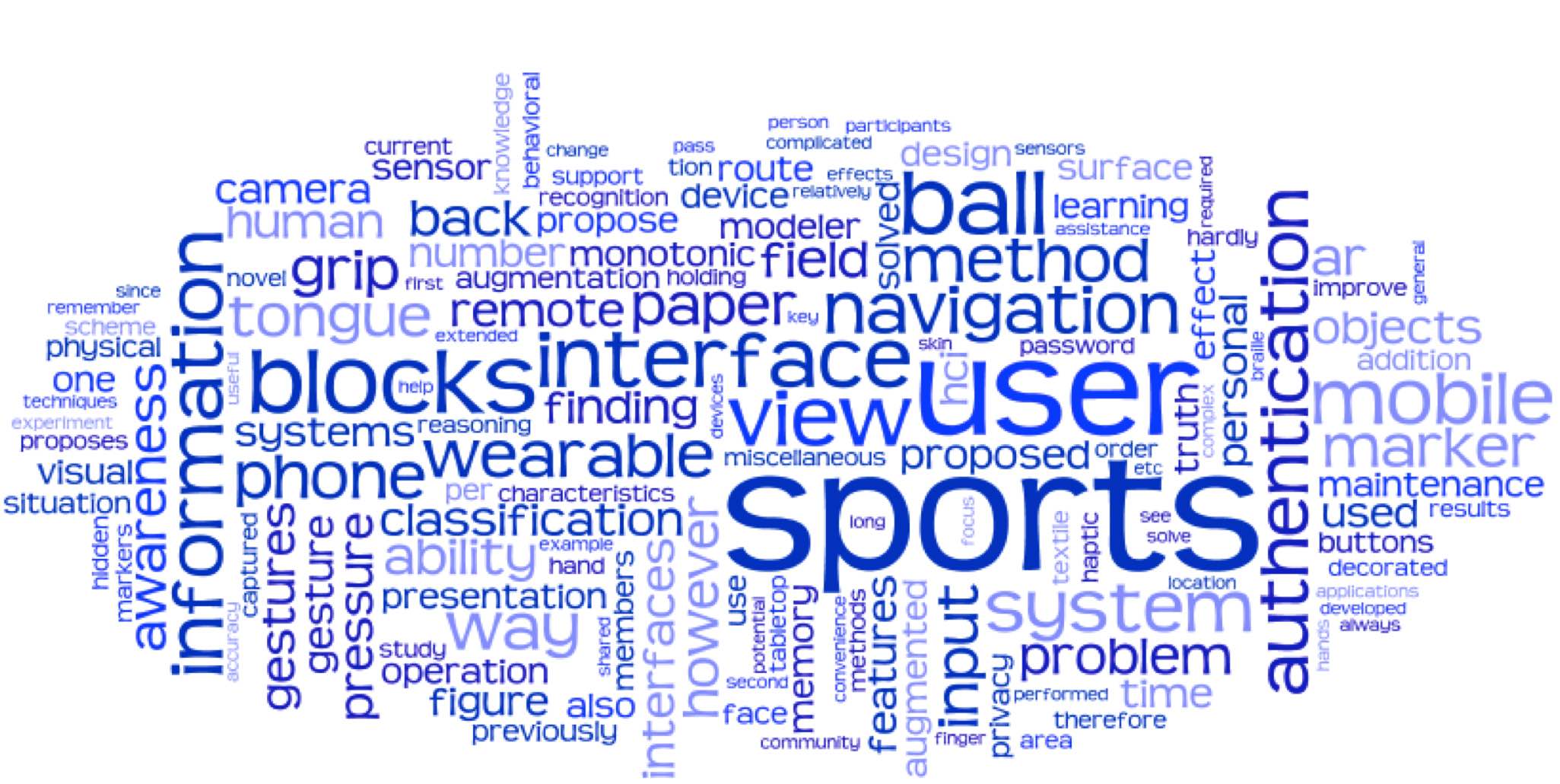
Ok, I’m “a bit” biased as I’m one of the conference co-chairs. Still I enjoyed this years Augmented Human. Below is the tag cloud from all abstracts, to give you a brief overview about the topics.

Tag Cloud

Considering the small size of the conference, the quality of the work is exceptional. It’s not one of the conferences that gets the rejected papers from CHI, Ubicomp, PerComp etc. The steering committee really set up a venue for far-out, novel ideas. Also it’s a good opportunity to meet great researchers up close; last year for example Thad Starner, Albrecht Schmidt etc. this year, Jun Rekimoto, Masahiko Inami, Paul Lukowicz and especially Yoshiyuki Sankai … pretty impressive if you ask me. They might be around at other bigger events, yet try to catch them and talk to them, impossible. At AH, it’s very easy. I recommend any young researcher interested in the research topics to attend next year’s AH. Surely, I will try to get some papers accepted ;)

[Read More]

Beyond FuturICT

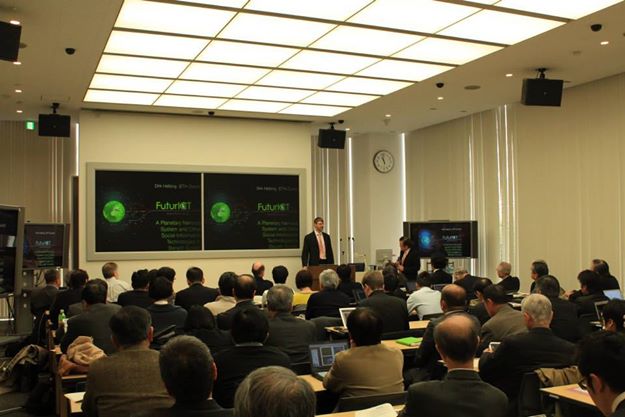
Attending the International Symposium on Service Systems Science on the 26.02.2014 in Tokyo, I got a glimpse on how the next steps of FuturICT and how similar projects and efforts are on their way in Japan.

Although the FuturICT project did not get funding from the EU so far (I still believe this was a grave mistake), I can see that the spirit and our ideas live on. The Japanese COI-T Program focuses on the same issues and problems as FuturICT.

FuturICT

Dirk Helbing’s presentation gave an overview of the FuturICT effort and the refined research agenda. I really enjoyed seeing how the material has matured. Also the talks from Shunri Oda and Maso Fukuma addressed similar problems and presented similar conclusions.

[Read More]

Glass Talk at Hacker News Kansai

Introducing Google Glass to Hacker News Kansai Community was a lot of fun.

Glass 1 Glass 2

I’m sorry it took so long to put online. Too much to do, especially due to Augmented Human 2014 (really looking forward to the beginning of march) :)

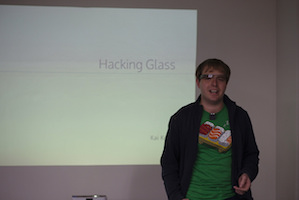
As part of our monthly Hacker News meetupin Kansai, I gave a small introduction on how to use (and hack for) Google Glass.

The “Hacks” are fairly simple. I more or less show how to develop for Glass using the Native Development Kit and some demonstrations how to read out sensors or other demo code I scraped from github and adjusted (see the slides for links to the sources). The examples include CameraZoom, Face Detection and Blink Recognition.

[Read More]

Looking back at 30C3

Impressions and Talk Recommendations. Finally, a couple of days with normal people ...

Honestly I was impressed by the professionalism of the 30th Chaos Communication Congress. It changed a lot from the last time I visited ( 25c3), grew bigger without loosing its atmosphere. With the assemblies and workshops the event starts to get more and more interactive.

Talk Recommendations

I link to the youtube streams of the recordings yet you can get them also over at media.ccc.de

[Read More]

30C3 Toward a Cognitive Quantified Self

Discussing activity recognition for the Mind and its potential applications.

Here are my talk slides for my 30c3 talk … Sorry it took so long. Thanks for the great feedback, will write a bit more if I have sometime ;)

The video is also online. This happened very quick after the event. I’m impressed by the 30c3 content team.

Thanks a lot for the great reviews and suggestions. They are highly appreciated. You can still review the talk.

[Read More]

Hacking Glass

So I got my hands on another Glass device and can now play with it a bit longer.

Disclaimer: Rooting and flashing your device voids your warranty and can brick your Glass. Also you won’t receive OTA updates afterwards. This is not an instruction manual. I just use it as a scratch pad to give a record what I did and what worked for me. The commands below will erase all data on your device. Proceed at your own risk.

[Read More]

Bits and Bytes instead of a Bookshelf

An interview made me wonder about how reading habits are changing and how we will narrate stories in the future.

Recently, I gave an interview for the German online issue of the Scientific American (Spectrum der Wissenschaft) for a special about reading habits (in German, paywall).

As I’m interested in the topic, I often hear that “endless scrolling” is bad as it destroys the mental map we make of books and pages or that reading from backlit screens is eye-straining inducing headaches. Personally, I cannot really understand these complaints. I’m doing most of my reading on tablet devices or computer screens though I never experienced these problems directly.

[Read More]